
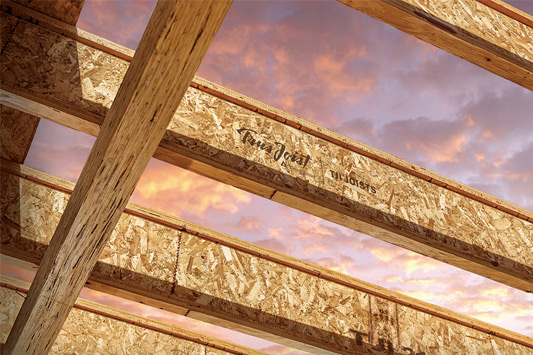
Trus Joist® TJI® joists are a key part of making a high-performance floor. The dimensional stability of TJI joists help them resist warping, twisting and shrinking that can lead to squeaky floors. TJI joists are lightweight and come in long lengths, which makes them faster and easier to install than traditional framing, and saves you both time and money.
TJI JOIST BENEFITS
- Easily drilled and cut for plumbing and ductwork
- Long lengths allow for versatile floor plans
- Ease of installation helps reduce callbacks
- TJ-Pro™ Rating provides customizable, predictable floor performance
- Save time and money and increase customer satisfaction
- Durable performance backed by a limited lifetime product warranty
TJI® joists are available in six series. Available depths range from 9½ to 24 inches in standard increments. Standard-size joists (9½"–16") are the most widely stocked through Weyerhaeuser's network of distributors and dealers; deeper sizes (18"–24") are suited for heavier-duty loads in multi-family and light commercial structures. Not all products may be available in all regions.
| Series | Flange Width | Available Depths | Web Thickness | Typical Application |
|---|---|---|---|---|
| TJI® 110 | 1¾" | 9½", 11⅞", 14", 16" | 3/8" | Residential floors and roofs |
| TJI® 210 | 2 1/16" | 9½", 11⅞", 14", 16" | 3/8" | Residential floors and roofs |
| TJI® 230 | 2 5/16" | 9½", 11⅞", 14", 16" | 3/8" | Residential floors and roofs |
| TJI® 360 | 2 5/16" | 9½", 11⅞", 14", 16", 18", 20" | 3/8" | Longer spans, higher loads |
| TJI® 560 | 3½" | 9½", 11⅞", 14", 16", 18", 20" | 7/16" | Longest spans, heaviest loads; multi-family and light commercial |
| TJI® 560D | 3½" | 18", 20", 22", 24" | 7/16" | Deep-depth applications; heavier-duty loads |
↑ For exact design properties, moment resistance, and shear values by depth, see the Design Properties tables in TJ-4000. Contact your Weyerhaeuser representative for regional availability.
Frequently Asked Quetions
What are Weyerhaeuser Trus Joist® TJI® joists?
Trus Joist® TJI® joists are engineered wood I-joists manufactured by Weyerhaeuser, designed for floor and roof framing in residential and light commercial construction. They are engineered for strength and consistency, resist bowing, twisting, and shrinking, and are available in long lengths, up to 60 feet, to support more versatile framing plans. TJI joists are manufactured in six series (110, 210, 230, 360, 560, and 560D) and range in depth from 9½ to 24 inches depending on series. Full product and design information is published in Weyerhaeuser's Trus Joist® TJI® joist Specifier's Guide, TJ-4000(US) and TJ-4500(Canada).
What series and depths are available for TJI® joists?
Trus Joist® TJI® joists are available in six series: 110, 210, 230, 360, 560, and 560D. Depending on series, available depths include 9½", 11⅞", 14", 16", 18", 20", 22", and 24". Standard-size joists (9½"–16") are typically the most widely available through local distributors and dealers. Deeper joists (18"–24") are suited for multi-family and light commercial applications. Not all products are available in all regions, contact your Weyerhaeuser representative for local availability or visit Weyerhaeuser’s ‘Where to Buy’ on our website.
Can I cut holes in TJI® joists to facilitate mechanicals?
Yes! Trus Joist® TJI® joists are designed to accommodate field-cut holes in the web for mechanical, electrical, and plumbing. Round, square and rectangular holes are permitted, subject to size and location limits published in TJ-9015 (Allowable Holes for Trus Joist® Products), TJ-4000 (US) and TJ-4500 (Canada). Holes must fall within the allowable zone relative to supports. Field-cut holes are not permitted in the hatched zone near bearings, though pre-engineered knockouts are permitted. Flanges should not be cut or notched. For TJI 360 and 560 joists, a 24-inch wide rectangular hole is also permitted at the center of a simple span under specific conditions. Use ForteWEB® or Javelin® for conditions outside the standard tables.
What is TJ-Pro™ Rating and how does it apply to TJI® joists?
TJ-Pro™ Rating is a proprietary floor performance diagnostic tool developed by Weyerhaeuser, that goes beyond the code’s strength and static deflection requirements to help specifiers, homeowners, and builders gauge a floor’s performance. Based on research conducted on approximately 1,000 floor system assemblies, it assigns a point value up to 65 that corresponds to customer satisfaction. At 45 points, 84% of customers are satisfied; at 65 points, satisfaction approaches 100%. Key factors include joist depth and span, composite action between the joists and floor sheathing, joist spacing, deck thickness/stiffness, and ceiling attachment. TJ-Pro Rating analysis is available through Weyerhaeuser's ForteWEB® and Javelin® software platforms.
Can TJI® joists be used for roof framing?
Yes! TJ-4000(US) and TJ-4500(Canada), include roof span and load tables for Trus Joist® TJI® joists. Note, TJI® joists require a ridge beam or other vertical support at the high end in roof applications. Weyerhaeuser also publishes a Roof System Design Guide (TJ-9005) for additional roof framing details for other Trus Joist engineered wood products. Installation guidance for both floor and roof framing is covered in TJ-9001.
What code evaluations cover Weyerhaeuser TJI® joists?
Trus Joist® TJI® joists obtain code approval through ICC-ES Evaluation Report ESR-1153, recognized under the International Building Code (IBC) and International Residential Code (IRC) for alternative materials. For Canadian projects, refer to CCMC ER No. 13132-R, for applicable Canadian code evaluations.
How should TJI® joists be protected for fire-safe construction?
All floor framing materials, including TJI® joists, benefit from appropriate fire protection. Weyerhaeuser notes in TJ-4000 that applying a protective membrane such as gypsum ceiling board provides passive fire protection for framing systems. For projects requiring specific fire-resistance ratings, TJ-1500 (Fire-Rated Assemblies and Sprinkler Systems) provides detailed fire-rated assembly configurations for Trus Joist® products. Designers should consult TJ-1500 and the applicable building code for their project's fire protection requirements.
Do TJI® joists require bridging or mid-span blocking?
TJI® joist floor framing does not require bridging or mid-span blocking. However, joists must be laterally supported at cantilever and end bearings by blocking panels, hangers, or direct attachment to a rim board or rim joist. Safety bracing must be installed during construction , joists are unstable until laterally braced. Only engineered lumber should be used for rim board and blocking; sawn lumber may shrink after installation. See TJ-9001 for complete installation requirements.
What software is available for designing with TJI® joists?
Weyerhaeuser offers ForteWEB®, a free web-based structural design tool, and Javelin®, a software platform. Both provide TJ-Pro™ Rating and handle design conditions beyond the printed span tables in TJ-4000, including multi-span conditions, point loads, and hole conditions requiring analysis.
What is the difference between TJI 360 and TJI 560 joists?
Both the TJI® 360 and TJI® 560 are higher-capacity series. The TJI 560 has a wider flange (3½" versus 2 5/16") and a thicker web (7/16" versus 3/8"), resulting in higher moment resistance and shear capacity. The TJI 560D is a deep-depth variant of the 560, with a 1.5”x3.5” flange to meet the code recognized 1-hour, 1-layer fire assembly, available in 18"–24" depths. For specific design considerations by depth and series, see the Design Properties tables in TJ-4000, or use ForteWEB® or Javelin® to compare performance for a specific span and load condition.
Product Literature
- tj-9001 - Installation Guide for Floor and Roof Framing with TJI 110, 210, 230, 360 and 560 Joists
- tj-9001F - Guide D’installation Pour Ossature De Plancher Et De Toiture
- tj-9006 - Installation Guide for Deep Depth TJI 360, 560 and 560D Joists
- csg-tjus25 - Simpson Connector Guide for Trus Joist Products (U.S.)
- 5036 - Mitek Connector Guide for Trus Joist Products
- tj-9015 - Allowable Holes for Trus Joist Products
- 9030 - Floor Framing Standards Guide: A Framer’s Guide to the Installation Process
- tj-9001p - Installation Guide for TJI 110, 210, 230, 360 and 560 Joists (in Punjabi language)
- csg-tjcan25 - Simpson Connector Guide for Trus Joist Products (Canada)
- USP994-131 - Mitek Connector Guide for Trus Joist products (Canada)
- tj-9001s - Guia de instalación para armazones de entrepisos y techos con viguetas TJI 110, 120, 230, 360 y 560
- tj-4500f - Solives TJI 110, TJI 210, TJI 230, TJI 360, TJI 560 ET TJI 560D
- vg-canada - Visual Literature Guide - Canada
- tj-4016 - Allowable Holes for TJIs Pocket Card
- tj-1020 - Termite Treatments Approved for Trus Joist® Engineered Wood Products - Hawaii
- tb-836 - Accommodating Duct Holes in TJI® Joists
- tj-4000 - SPECIFIER'S GUIDE FOR TJI 110, 210, 230, 360, AND 560 JOISTS - USA
- TJ-1500 - Fire-rated Assemblies and Sprinkler Systems
- tj-4035 - Sound Performance of Trus Joist TJI Joist Fire-Rated Floor Assemblies
- as-tjign - Trus Joist Product Specification General Notes
- as-tji - Architectural Specifications: TJI Joists
- sr-111 - Hazards of Deviating from Framing Specs
- tj-4500 - Specifier's Guide for TJI 110, 210, 230, 360, and 560 Joists - Canada
- 1502 - Using Weyerhaeuser Products in Conventional Construction
- tb-104 - Information About Floor Performance
- tb-105 - Elevated Garage Floors with Weyerhaeuser Structural Composite Lumber
- tb-112 - Moisture Effects on Weyerhaeuser Engineered Wood Products and Oriented Strand Board
- tb-120 - Engineer's Seal Requirements for I-Joists, Structural Composite Lumber and Plated Trusses
- tb-125 - Wind Uplift Design for Trus Joist® TJI® Roof Joists
- tb-203 - Attaching Fire Sprinkler Components to Trus Joist® TJI® Joists
- tb-206 - Fastener Spacing in Weyerhaeuser Engineered Wood Products
- tb-213 - Flood Damage-Resistant Material Considerations
- tb-216 - Stacking Gypsum Board on Floor Framing During Construction
- tb-224 - Guidelines for Notches in Rim Board
- TB-225 - LRFD Format Conversion Factors for Weyerhaeuser TJI® Joists
- tb-227 - Rim Board Products Acceptable for Use with TJI® Joists
- tb-310 - Use of Topical Coatings with Weyerhaeuser Engineered Wood Products
- tb-315 - Preservative Wood Treatments of Weyerhaeuser Engineered Wood Products
- tb-316 - Forklift Recommendations for Trus Joist® Engineered Wood Products
- tb-319 - Weyerhaeuser Engineered Wood Products Header-Off Span Table
- tb-805 - Trus Joist® TJI® Ceiling Joist Supporting Attic Load
- tb-808 - Attachment Connections to TJI Joist Bottom Flange
- tb-813 - Trus Joist® TJI® Joist Residential Bonus Room Span Tables
- tb-817 - Holes Too Close to End Bearing
- tb-818 - Flange Notches in TJI Joists
- tb-820 - Connection Details for 3-Ply TJI® Joists
- tb-824 - Trus Joist® TJI® Ceiling Joist Supporting Attic Load and Roof Thrust Load
- tb-825 - Solar Panel Attachment to Trus Joist TJI Joist Flanges
- tb-826 - Parallel joist blocking with end blocks
- tb-827 - Wall tension tie connectors for TJI joists
- tb-834 - Maximum Point Load Applied to Either Member of 2-Ply TJI® Joists
- tb-929 - Proprietary Sheathing Fasteners
- tb-354 - Weyerhaeuser Engineered Wood Products Quick Reference Guide for Building Officials and Building Designers
- tb-859 - TJI® Joists with an Inadvertent Side Flange Notch in the Top (Compression) Flange
- tb-158 - Engineering Requirements for I-Joists, Structural Composite Lumber, and Plated Trusses
- tb-860 - TJI® Joists Header-Off Span Table (Canada)
- tb-156 - Weyerhaeuser Edge Gold™ Floor Panel Deflection Comparison
- TB-861 - Maximum Factored Point Load Applied to Either Member of 2-Ply TJI® Joists (Canada)
- tb-155f - Calcul de diaphragmes horizontaux avec solives Trus Joist TJI
- tb-853 - Canadian Vibration Criteria – TJI® Joist Bridging and Resilient Channels
- tb-155 - Horizontal Diaphragm Design with Trus Joist® TJI® Joists
- tb-132 - Holes and Flange Interferences in TJI® Joists
- tb-320 - Weyerhaeuser SCL Floor Framing Supporting Guards
- tb-839 - Installing a Replacement EWP Joist Adjacent to a Damaged EWP Joist
- TB-314 - Fire Retardant Coatings of Weyerhaeuser Engineered Wood Products
- tb-832 - Repair Detail for a Notch in the Top (Compression) Flange of TJI® Joist
- tb-838 - Repair Detail for a Hole in a TJI® Joist
- TNC-22-08 - Plans Examiner Tool Kit
- tb-321 - Supplemental Guide for Weyerhaeuser SCL Floor Framing Supporting Guards
- var-1008 - ICC-ES SAVE Report No. VAR-1008
- esr-1153 - U.S. and City of LA ICC-ES Report No. ESR-1153
- tj-9013 - Trus Joist Products Satisfy Code Fire Protection Requirements
- ruling-no05-06-130r - Ruling No. 05-06-130 (13132-R)
- fl1630 - State of Florida FL1630-R16
- spec-id-26948 - Intertek TJI Fire Listings
- ccmc13132-r-f - Canadian CCMC ER No. 13132-R (Évalué par le CCMC)
- ccmc13132-r - Canadian CCMC ER No. 13132-R (Evaluated by CCMC)
- tj-9513 - Fire Protection of Residential Floors in Canada
- 1505 - Questions and Answers About Adhesives and Formaldehyde Emissions
- tji-joist-sds - TJI Joist
- tji-joist-flak-jacket-sds - TJI Joist with Flak Jacket Protection